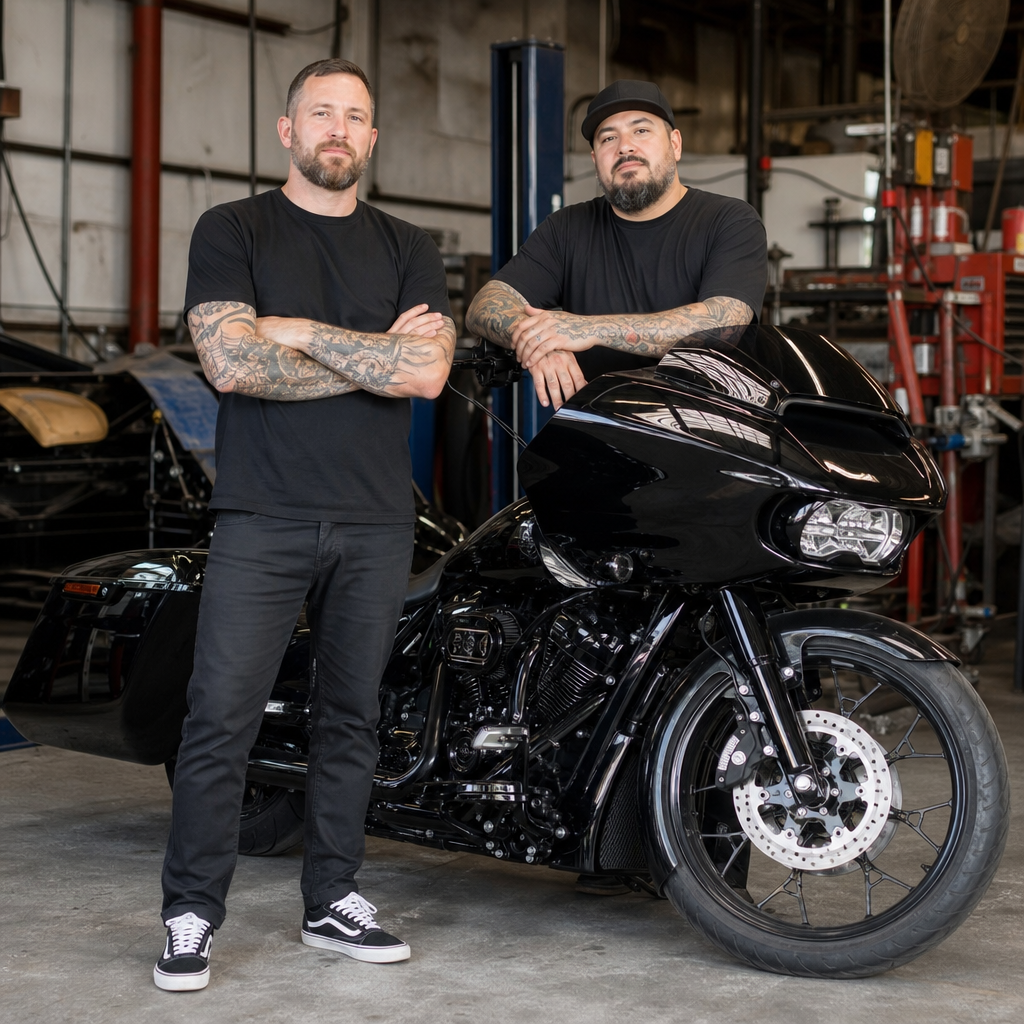
Cody Beasterfield and Danny Garcia represent two ends of the same 2026 Road Glide customizer movement: one shaped by digital-era fabrication, the other by hard-earned legacy, both pushing Harley-Davidson’s fixed-fairing bagger into the center of modern custom culture. In builder circles, “Road Glide customizers” refers to fabricators, tuners, finish specialists, and design-led shops that transform the stock FLTR platform into purpose-built motorcycles with stronger performance, sharper handling, more integrated electronics, and unmistakable visual identity. The phrase “New Guard” describes the current wave of builders blending CNC machining, CAD surfacing, 3D scanning, CAN bus integration, and media-savvy branding with traditional metal finishing, chassis setup, paint, and final assembly discipline. “Legendary builders” refers to established names whose influence predates the social media era yet continues to define what quality, proportion, and rideability mean in the custom scene.
This hub matters because the 2026 Road Glide is not just another touring bike in the custom market. It is the benchmark platform for premium bagger building, audio integration, performance touring, and show-level finishing. Harley-Davidson’s recent Touring chassis refinements, the popularity of the Milwaukee-Eight engine family, and the rise of high-end aftermarket brands have created a mature ecosystem where builders can radically change geometry, bodywork, suspension response, wheel fitment, braking confidence, and rider interface without losing long-distance usability. I have worked around custom bagger projects long enough to know that the difference between a good Road Glide build and a forgettable one is rarely a single expensive part. It is the builder’s judgment: what to cut, what to retain, what to machine, what to tune, and how to make every change work together on the road, not only under show lights.
As the sub-pillar hub for profiles of 2026 New Guard and legendary builders, this page maps the people, methods, and standards shaping the current scene. Cody Beasterfield and Danny Garcia are the lead examples because their names frame a bigger story about where the Road Glide world is going. One signals the next-generation expectation for engineered customization. The other represents continuity, taste, and credibility built over years of visible work. Together, they help explain why the 2026 Road Glide custom market rewards builders who can merge style, reliability, fabrication accuracy, and a deep understanding of rider demand.
Why the 2026 Road Glide Sits at the Center of Custom Culture
The Road Glide has become the premier custom bagger canvas because its sharknose fairing, long wheelbase, stable chassis, and touring architecture support both aggressive visual changes and genuine performance upgrades. Unlike many customs that become compromised after heavy modification, a well-built Road Glide can gain cornering clearance, braking feel, wind management, and luggage practicality while still carrying oversized audio systems, large-diameter front wheels, stretched bags, or custom body kits. That balance is why builders keep returning to the platform.
In 2026, the most respected Road Glide customizers are not judged by paint alone. They are judged by integration. A 26-inch front wheel build, for example, is only credible when trail, rake effect, fender clearance, fork damping, brake line routing, and low-speed manners are solved together. The same applies to saddlebag stretching, neck work, air-ride installation, DSP-driven audio packaging, and handlebar ergonomics. A custom bagger that photographs well but overheats, drags hard parts early, or develops electrical faults after one summer will not hold respect among experienced riders.
The platform also attracts diverse buyer types. Some want performance baggers with Ohlins or Legend suspension, radial brakes, torque-focused cam packages, and forged wheels. Others want show-caliber baggers with engraved components, molded body lines, color-matched inner fairings, and hidden wiring. Many want both. That demand created space for builders like Cody Beasterfield and Danny Garcia to shape different customer expectations while still working on the same foundational motorcycle.
Cody Beasterfield and the New Guard Builder Model
Cody Beasterfield stands for the 2026 builder who treats customization as a full-system design problem. In practical terms, that means beginning with accurate measurement, digital mock-up, and fitment planning before committing to irreversible cuts or cosmetic finishing. New Guard builders work faster than older custom shops in some stages because they use 3D scanning, digital templates, CNC-cut brackets, repeatable harness planning, and supplier partnerships that reduce rework. But speed is not the real advantage. Consistency is.
When I evaluate builders in this lane, I look for signs that they understand production tolerance and serviceability. Can the fairing come apart without destroying a paint edge? Is the audio rack removable? Are aftermarket neck cups, trees, and fork assemblies installed to a known geometry target rather than visual guesswork? Are CAN-based lighting and switch functions retained cleanly? Builders associated with the New Guard win trust when they answer those questions early, because modern Harley touring electronics and body systems punish sloppy planning.
Beasterfield’s significance in a hub like this is less about one isolated motorcycle and more about what his profile suggests: a builder identity defined by engineering fluency, branded aesthetics, and a willingness to combine fabrication with data. Many newer Road Glide customizers now use brake upgrade calculators, suspension sag targets, steering stop verification, and thermal management planning as naturally as older generations used masking tape and cardboard mockups. The result is a cleaner class of custom motorcycle, especially in the premium six-figure build space where clients expect OEM-level finish with aftermarket individuality.
Danny Garcia and the Value of Legendary Builder Credibility
Danny Garcia represents something that cannot be downloaded from software or purchased through a machine catalog: established taste. Legendary builders matter in 2026 because custom culture still depends on trust, memory, and proof of execution over time. A builder who has delivered motorcycles across changing style eras learns proportion in a way that trend-chasing shops often do not. That experience shows in stance, paint line flow, part restraint, and an intuitive understanding of where visual drama becomes clutter.
Garcia’s place in the Road Glide conversation reflects the enduring importance of rideable customs. Builders with long reputations tend to know where customers regret overbuilding. Excessively thin tire clearance, inaccessible battery placement, overcomplicated audio wiring, and fragile molded panels can all create future frustration. Seasoned builders avoid those traps not because they are conservative, but because they have seen the repair orders. They know that a touring custom must survive heat cycles, weather, vibration, luggage loads, and owner neglect if it is going to remain admired after the reveal season ends.
That practical credibility gives legendary builders a different kind of authority in the New Guard era. They validate trends selectively. If they adopt billet floorboards, brake upgrades, stealth audio integration, or stretched tank-console transitions, they do it because the solution works, not because the market is temporarily excited. For buyers and readers, Garcia serves as a reference point: if a builder profile cannot explain why a modification improves the motorcycle, it is style without conviction.
What Defines a Top 2026 Road Glide Build
The best 2026 Road Glide builds share a recognizable checklist of priorities. They begin with a coherent theme, then solve fitment, comfort, and reliability before final finishing. Performance upgrades usually include suspension work from brands such as Ohlins, Fox, Legend Suspensions, or Kraus-supported front-end setups; braking improvements through larger rotors, quality pads, and often Brembo or similarly respected components; wheel and tire packages selected around geometry rather than fashion alone; and engine tuning built on realistic use cases. A road-trip bagger benefits more from strong midrange torque, oil temperature control, and stable fueling than from a dyno number that hurts drivability.
Bodywork standards have also risen. Builders are expected to manage panel gaps, fender centering, bag-lid alignment, and fairing surface transitions at a near-coachbuilt level. Paint is no longer just color; it is part of the motorcycle’s design language. Finishes may include layered candies, brushed-metal effects under clear, ghost graphics, hand striping, laser-etched details, or ceramic-coated exposed metal. Interior touchpoints matter too: bar position, seat foam density, grip diameter, shifter feel, and display visibility all affect whether a custom feels premium after three hours in the saddle.
| Build Area | What Serious Builders Focus On | Why It Matters on a Road Glide |
|---|---|---|
| Chassis geometry | Wheel size, trail effect, neck setup, fork length, steering stops | Preserves low-speed control and high-speed stability |
| Suspension | Spring rate, damping, sag, rear travel, fork cartridge quality | Improves cornering, braking, passenger comfort, and tire contact |
| Body integration | Panel fit, bag alignment, fender clearance, hidden fasteners | Separates refined customs from rushed cosmetic jobs |
| Electrical and audio | Load management, CAN compatibility, DSP tuning, service access | Prevents failures and keeps touring features usable |
| Powertrain | Cam choice, fueling, cooling strategy, clutch setup, exhaust balance | Delivers reliable torque without sacrificing longevity |
How Builder Profiles Help Buyers, Enthusiasts, and the Industry
A hub focused on profiles is useful because the custom world can look deceptively uniform online. Similar wheels, paint colors, and bagger silhouettes can mask very different levels of craftsmanship. Builder profiles reveal process. They show whether a shop develops repeatable solutions, how it sources components, what kind of riding it designs for, and how it handles the tradeoff between show presence and road function. That information helps buyers avoid costly mistakes and helps enthusiasts understand why one motorcycle feels composed while another feels improvised.
Profiles also preserve lineage. The custom bagger scene did not appear overnight; it evolved through regional styles, dealer cultures, performance influences, and fabrication breakthroughs. Featuring both New Guard names and legendary builders keeps that history intact while showing where current innovation is happening. For the industry, this matters because aftermarket parts manufacturers, tuners, painters, upholsterers, and media outlets all benefit when standards are visible. Better-informed customers ask better questions, and better questions tend to produce better motorcycles.
For this subtopic, Cody Beasterfield and Danny Garcia anchor a broader editorial map. Around them sit future profiles covering performance-led bagger specialists, elite paint and finish houses, CNC-forward fabrication shops, audio-heavy touring customizers, and hybrid builders who merge club-style handling with full-dress touring presence. As a hub page, this article should help readers identify which builder philosophies match their goals before they dive deeper into individual profiles.
The Future of the Road Glide Custom Scene
Looking ahead, the 2026 Road Glide custom scene will be defined by tighter integration, lighter components, and more evidence-based setup. Expect more builders to use scan-to-part workflows, in-house small-batch billet production, composite body sections, modular audio enclosures, and chassis data gathered from actual road testing. Suspension and brake tuning will continue to separate premium builds from decorative ones, especially as riders expect large-wheel baggers to corner and stop with more confidence than older customs ever did.
At the same time, the market will continue rewarding authenticity. Builders who understand why the Road Glide matters to riders—not just cameras—will outlast trend cycles. That is why pairing Cody Beasterfield and Danny Garcia in one conversation makes sense. Beasterfield symbolizes the technical, media-literate, fabrication-driven future. Garcia symbolizes the lasting value of judgment, restraint, and proven execution. The strongest customizers will combine both approaches: digital precision with human taste.
If you are exploring 2026 Road Glide customizers, use this hub as your starting point for the wider world of New Guard and legendary builders. Learn the names, study the methods, compare the philosophies, and pay attention to motorcycles that work as well as they look. The real benefit of following builder profiles is clarity. You begin to see which shops create complete motorcycles rather than collections of parts. From there, the next step is simple: dive into the connected profiles in this series and decide whose vision best matches the Road Glide you want to build or ride.
Frequently Asked Questions
Who are Cody Beasterfield and Danny Garcia in the world of 2026 Road Glide customizers?
Cody Beasterfield and Danny Garcia are often framed as representing two complementary paths within the modern Road Glide customizing scene. Beasterfield is associated with the newer wave of design-driven fabrication, where digital planning, precision machining, advanced finishing methods, and contemporary performance integration play a major role in how a build comes together. Garcia, by contrast, reflects the legacy side of the culture: hands-on experience, deep platform familiarity, hard-earned shop instincts, and a builder mindset shaped by years of evolving Harley-Davidson touring motorcycles through real-world craftsmanship.
What makes them important in the 2026 Road Glide conversation is not simply name recognition, but what they symbolize. Together, they illustrate how the fixed-fairing bagger has become one of the most serious platforms in custom motorcycling. In this context, “Road Glide customizers” does not refer only to cosmetic bike builders. It includes fabricators creating one-off bodywork, tuners refining power delivery, suspension specialists improving chassis response, wheel and brake experts optimizing control, and finish professionals delivering show-level paint, coatings, and detail work. Beasterfield and Garcia stand at different points on that spectrum, yet both point toward the same outcome: a Road Glide that is more purposeful, more personal, and more capable than stock.
That is why their names resonate in the 2026 scene. They help define a movement in which the Road Glide is no longer viewed just as a comfortable touring Harley, but as a modern custom platform capable of carrying high-end aesthetics, aggressive performance, and a distinct identity within contemporary motorcycle culture.
What does “2026 Road Glide customizer movement” actually mean?
The phrase refers to the current evolution of builders and shops transforming the Harley-Davidson FLTR platform into something far beyond its factory configuration. By 2026, the Road Glide has become a focal point for customizers because it offers a stable chassis, strong touring roots, a recognizable fixed-fairing silhouette, and enough aftermarket support to let builders dramatically rework nearly every major system on the motorcycle. As a result, the platform sits at the intersection of performance bagger culture, show bike craftsmanship, long-distance usability, and brand-driven personalization.
In practical terms, the movement includes several overlapping disciplines. Fabricators redesign body lines, stretch or tighten visual proportions, and integrate custom side covers, saddlebags, lighting, and audio solutions. Performance shops upgrade engines, cam packages, exhaust systems, intake flow, cooling strategies, and ECU calibration to produce stronger, more usable power. Chassis specialists address front-end geometry, rear suspension travel, braking consistency, wheel fitment, and overall handling balance. Finish experts add another layer through paint, powder coat, machining detail, texture contrast, and material selection. The end result is a machine that feels engineered rather than simply accessorized.
What makes the 2026 version of this movement especially significant is its blend of old-school credibility and modern capability. Some builders rely on digital scanning, CAD design, CNC machining, and highly controlled production methods; others lean on traditional metalwork, visual instinct, and years of shop-tested knowledge. The strongest builds often combine both. That fusion is exactly why figures like Beasterfield and Garcia matter: they embody the idea that modern custom culture can be both technologically advanced and rooted in craft tradition.
Why has the Road Glide become such an important platform for custom builders compared with other Harley-Davidson models?
The Road Glide stands out because it offers a rare mix of visual identity, real-world functionality, and customization potential. Its fixed fairing immediately gives it a distinctive profile that separates it from other Harley-Davidson touring models, and that profile has become central to the visual language of modern bagger culture. Builders are drawn to bikes that can be recognized instantly, and the Road Glide provides a strong design foundation that can be pushed in multiple directions, from clean and understated performance builds to radical high-finish show machines.
Beyond looks, the platform is attractive because it responds well to meaningful upgrades. A stock Road Glide already starts with touring comfort, storage capacity, long-wheelbase stability, and a chassis built for sustained highway use. For customizers, that means there is room to improve nearly everything without losing the bike’s core usability. Suspension tuning can sharpen handling. Brake upgrades can improve confidence under hard riding. Engine work can turn the bike into a much more responsive machine. Ergonomic changes can tailor rider position. Body modifications can refine or completely reshape the visual package.
Another major reason is aftermarket depth. Builders can source performance internals, audio systems, wheels, body components, controls, lighting, seat options, and electronics from a wide network of manufacturers. That support allows shops to pursue highly specific outcomes, whether the owner wants a canyon-capable performance bagger, a competition-style audio build, a sleek street bike with custom paint, or a cross-country machine with premium fit and finish. In the hands of experienced customizers like the kinds represented by Beasterfield and Garcia, the Road Glide becomes a blank canvas with unusually high performance and design upside.
What kinds of modifications define a serious custom 2026 Road Glide build?
A serious 2026 Road Glide build is usually defined by how well the modifications work together, not by how many parts are added. The best builds begin with a clear intent. Some are designed around performance, others around visual impact, long-distance touring comfort, audio integration, or a balanced blend of all four. From there, skilled customizers typically focus on the areas that most dramatically reshape the motorcycle: power, suspension, braking, bodywork, ergonomics, and finish.
On the performance side, common upgrades include camshaft packages, intake and exhaust improvements, cylinder head work, cooling enhancements, clutch refinements, and precise ECU tuning. These changes are not just about producing bigger dyno numbers; they are about improving throttle response, torque delivery, rideability, and reliability under real use. Chassis work is equally important. High-end fork cartridges, upgraded rear shocks, improved triple trees, swingarm stabilization, and carefully selected wheel and tire combinations can transform the bike from a heavy cruiser into a far more composed and confidence-inspiring machine.
Visually, custom bodywork often includes reworked saddlebags, cleaner panel transitions, custom front and rear fenders, integrated lighting, modified side covers, and refined fairing details. Finish quality separates average builds from standout ones. Premium paint, coatings, machined accents, and intentional color/material coordination give the bike a complete, finished identity. Ergonomic upgrades such as bars, grips, floorboards, seats, and control placement are also critical because a truly successful custom Road Glide should feel as purposeful on the road as it looks at a show.
Perhaps most importantly, a serious build avoids the “parts catalog” look. Builders operating at the level associated with this 2026 customizer movement aim for cohesion. Every modification should support the bike’s intended personality. That is the difference between a modified Road Glide and a genuine custom motorcycle.
How do builders balance heritage and new technology when customizing a 2026 Road Glide?
The strongest builders do not treat heritage and technology as opposing ideas. Instead, they use each where it offers the most value. Heritage matters because Harley-Davidson touring culture has decades of visual cues, mechanical traditions, and rider expectations behind it. Experienced builders understand frame attitude, stance, proportion, ride feel, and the emotional qualities that make a Road Glide still feel like a Harley even after extensive customization. That instinct usually comes from years of physical work on motorcycles, repeated problem-solving, and direct knowledge of what performs well outside the showroom.
Technology, meanwhile, expands what is possible. Digital measurement tools, CAD-based design, CNC machining, improved tuning software, advanced coatings, additive manufacturing for prototypes, and more precise diagnostic systems allow modern customizers to build with tighter tolerances and better repeatability. These tools are especially useful when integrating body components cleanly, refining intake and exhaust systems, dialing in suspension setups, or ensuring that a bike with extensive changes still operates reliably as a complete machine.
In the 2026 Road Glide scene, the ideal balance is not nostalgia for its own sake and not technology for its own sake. It is thoughtful application. A legacy-minded builder may rely on visual judgment and decades of ride-based understanding, while also using modern tuning tools to get the engine exactly where it needs to be. A digitally oriented builder may design with software and machine with precision, while still respecting classic Harley proportions and rider feel. That is the broader lesson behind the contrast between Cody Beasterfield and Danny Garcia: the future of Road Glide customization belongs to builders who can honor the platform’s roots while pushing it forward with modern methods.